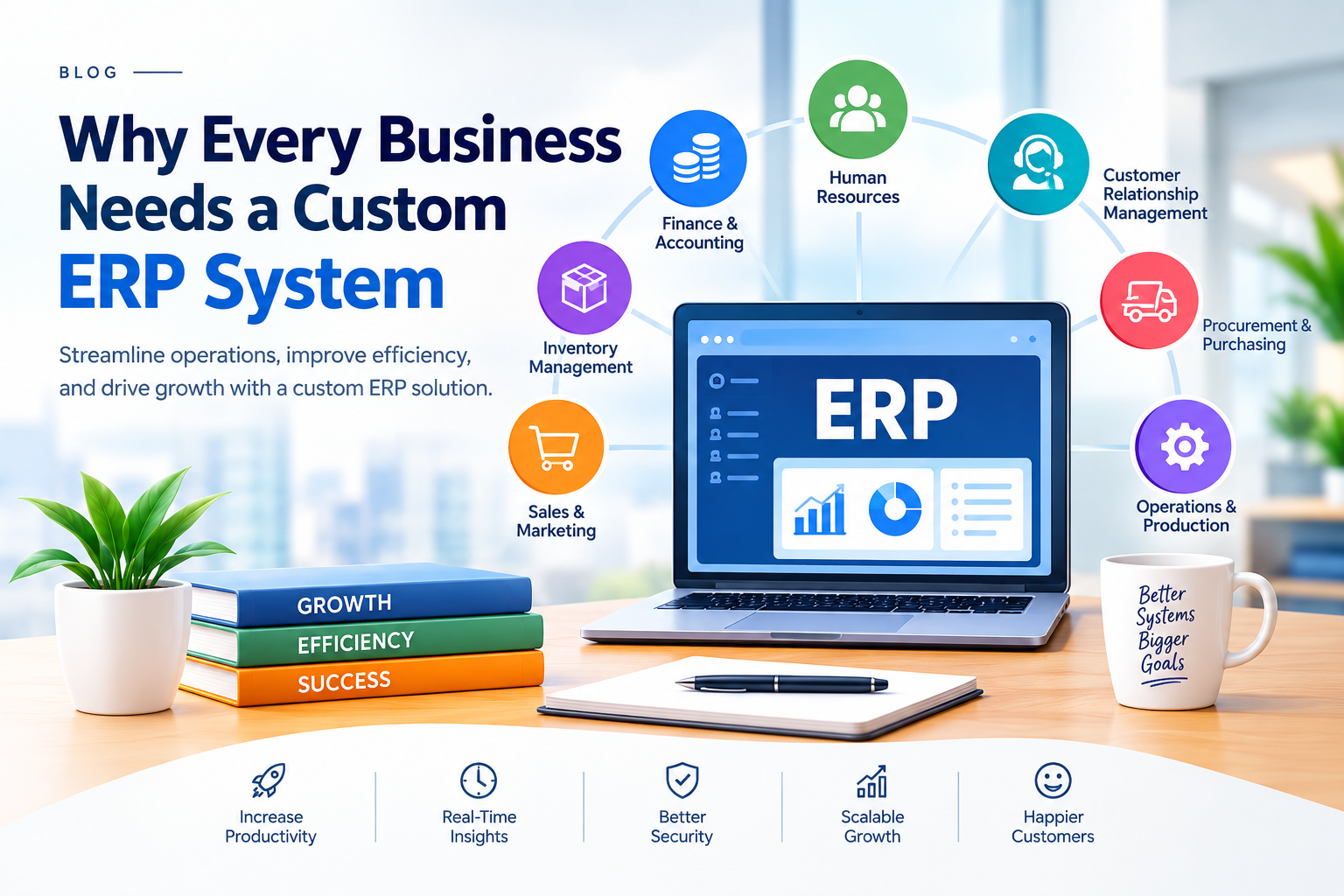
In today's fast-paced digital world, businesses are constantly looking for ways to improve efficiency, reduce operational costs, and gain a competitive advantage. One of the most effective solutions is implementing a Custom Enterprise Resource Planning (ERP) System.
What is a Custom ERP System?
A Custom ERP System is a centralized software solution tailored to a company's specific workflows, processes, and business requirements.
It connects multiple business functions into a unified platform, allowing teams to access real-time information and collaborate more effectively.
Common ERP modules include:
- Finance & Accounting
- Inventory Management
- Human Resources (HR)
- Customer Relationship Management (CRM)
- Sales & Marketing
- Procurement & Purchasing
- Project Management
- Manufacturing & Production
- Reporting & Analytics
Challenges Businesses Face Without ERP
Many businesses still rely on spreadsheets, multiple software applications, and manual processes to manage their operations. This often leads to:
Data Duplication: Employees enter the same information into multiple systems, increasing errors and reducing productivity.
Lack of Real-Time Insights : Management struggles to obtain accurate business data for decision-making.
Poor Communication : Departments work independently, creating information silos.
Increased Operational Costs : Manual tasks consume valuable employee time and resources.
Difficulty Scaling : As businesses grow, outdated systems become inefficient and difficult to manage.
Industries That Benefit from Custom ERP
Manufacturing : Production planning, inventory control, quality management.
Retail & E-Commerce : Order processing, stock management, customer tracking.
Healthcare : Patient records, billing, appointment scheduling.
Education : Student management, attendance, fee tracking.
Logistics & Transportation : Fleet management, shipment tracking, warehouse operations.
Human Resource Management : Employee records, payroll, recruitment, performance monitoring.
The Future of ERP Systems
The next generation of ERP systems will incorporate:
Artificial Intelligence (AI) : Predictive analytics and intelligent automation.
Machine Learning : Improved forecasting and business insights.
IoT Integration : Real-time monitoring of equipment and assets.
Business Intelligence Dashboards : Advanced reporting and performance analytics.
AI Agents : Automated customer support, reporting, and operational assistance.
Businesses that adopt these technologies early will gain a significant competitive advantage.
Looking for a Custom ERP Solution?
At Webzeee, we develop scalable and secure ERP solutions tailored to your business needs. Whether you're a startup, SME, or enterprise, our custom ERP systems help streamline operations and accelerate growth. Contact us today to discuss your requirements.